

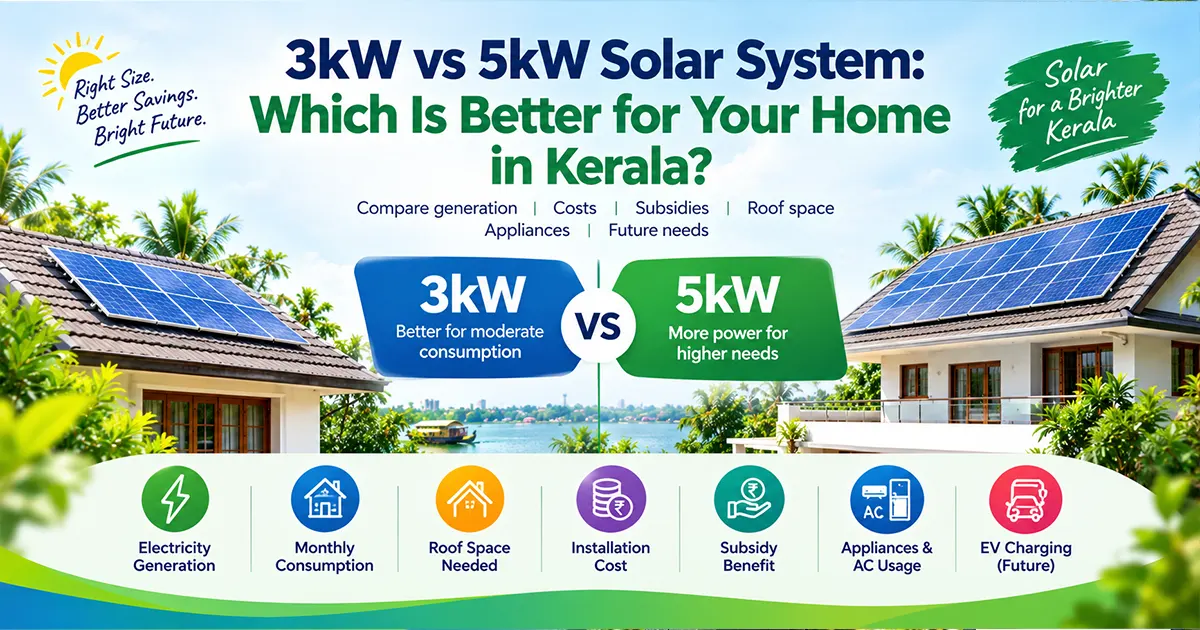
3kW vs 5kW Solar System: Which Is Better for Your Home in Kerala?
A 3kW solar system is usually suitable for Kerala homes with moderate electricity consumption, while a 5kW system makes more sense for larger households using more air conditioning, water heating, multiple appliances, or planning future EV charging. The better choice depends on monthly electricity use, available roof space, budget, and expected future demand.
Government guidance under PM Surya Ghar broadly associates 2–3kW systems with households consuming 150–300 units per month, while homes using more than 300 units may require a system above 3kW.
That does not mean every Kerala home using 300 units must install exactly 3kW. Roof shading, orientation, local weather, and consumption patterns also matter.
What Is the Difference Between a 3kW and 5kW Solar System?
The main difference is generation capacity.
A 3kW system has a rated solar array capacity of roughly 3 kilowatts, while a 5kW system has about 67% more capacity.
In practical terms, a 5kW system can:
- Generate more electricity each day
- Offset a higher monthly electricity bill
- Better support homes with several high-consumption appliances
- Provide more room for future electricity demand
- Require more roof space
- Cost more upfront
A 3kW system often works well for smaller or moderate-consumption households, particularly when the goal is primarily to reduce electricity bills.
A 5kW system becomes more attractive when household demand is consistently high or expected to increase.
How Much Electricity Can a 3kW vs 5kW Solar System Generate Per Day in Kerala?
KSEB states that each 1kWp of rooftop solar installed on a south-facing roof can generate about 4–6 units of electricity per day, although actual generation varies with weather conditions.
Using that broad KSEB range:
| System Size | Approx. Daily Generation | Approx. Monthly Generation* |
| 3kW | 12–18 units | 360–540 units |
| 5kW | 20–30 units | 600–900 units |
*Simple 30-day estimate before accounting for seasonal variation, shading, downtime, system losses and site-specific conditions.
The government also notes that an average 3kW rooftop system can generate more than 300 units per month.
For Kerala homes, actual production can vary considerably between summer and monsoon periods.
A shaded roof in central Kochi may generate less than an open, well-oriented roof elsewhere even if both systems have identical rated capacity.
Therefore, the installer should provide a site-specific annual generation estimate, not simply multiply 5kW by an ideal daily figure.
What Monthly Electricity Consumption Is Suitable for 3kW or 5kW Solar?
The simplest starting point is your electricity consumption in units, not the amount you pay in rupees.
PM Surya Ghar guidance gives the following broad system-sizing categories:
0–150 units/month: 1–2kW
150–300 units/month: 2–3kW
Above 300 units/month: Above 3kW
This means a 3kW system is a logical starting point for homes around the 150–300+ unit range, while a 5kW system may suit households consistently consuming substantially above 300 units.
For example:
A household averaging 250 units/month may find 3kW sufficient.
A household averaging 500–650 units/month with regular AC use may benefit more from considering 5kW.
But sizing should not be based on one unusually high summer bill.
Review at least 6–12 months of electricity bills to understand your actual consumption pattern.
How Much Roof Space Is Needed for 3kW and 5kW Solar?
Roof-space requirements depend on the wattage and dimensions of the modules selected.
Modern higher-wattage panels can produce the same system capacity using fewer modules than older, lower-wattage panels.
As a broad planning estimate:
3kW: roughly 180–250 sq. ft. of practical module area
5kW: roughly 300–450 sq. ft.
The actual roof area needed may be higher because installers must consider:
water tanks,
staircase structures,
parapet shadows,
panel spacing,
maintenance access,
orientation,
and structural limitations.
Suppose your home has 500 sq. ft. of terrace space but a water tank and neighbouring building shade around 200 sq. ft.
Your usable solar area may be much closer to 300 sq. ft.
That could make the practical difference between comfortably installing 3kW and struggling to fit an efficient 5kW layout.
A professional site survey is therefore essential before finalizing capacity.
How Much Does a 3kW vs 5kW Solar System Cost in Kerala?
There is no single fixed Kerala price because solar quotations vary by panel brand, inverter, structure, electrical work and installation conditions.
For broad 2026 planning purposes, residential on-grid systems in Kerala can commonly fall around:
3kW: approximately ₹1.5 lakh–₹2.15 lakh before subsidy
5kW: approximately ₹2.5 lakh–₹3.6 lakh before subsidy
These should be treated as indicative market ranges rather than official government prices.
The 5kW system costs more because it requires additional modules, a larger inverter configuration or differently sized inverter, more structure, cabling and associated equipment.
However, the cost per kW does not always increase proportionally. Larger systems can sometimes benefit from economies of scale.
When comparing quotations, check whether both systems use comparable:
panel models,
inverter brands,
mounting structures,
earthing and protection,
monitoring,
installation scope,
and warranty coverage.
A cheap 5kW system is not necessarily better value than a technically stronger 3kW system.
What Rooftop Solar Subsidy Is Available for 3kW and 5kW Systems?
Under the current PM Surya Ghar: Muft Bijli Yojana, the Central Financial Assistance for eligible residential households is:
1kW: ₹30,000
2kW: ₹60,000
3kW or more: ₹78,000 maximum subsidy
This creates an important comparison:
A qualifying 3kW system receives up to ₹78,000.
A qualifying 5kW system also receives up to ₹78,000.
The subsidy does not continue increasing beyond 3kW under the current structure.
For example:
If a 3kW system costs ₹1.8 lakh before subsidy:
₹1,80,000 − ₹78,000 = ₹1.02 lakh effective cost
If a 5kW system costs ₹2.8 lakh:
₹2,80,000 − ₹78,000 = ₹2.02 lakh effective cost
These are only simplified examples. Actual eligible project cost, vendor quotation and subsidy processing must be checked through the applicable portal.
For official details, homeowners can refer to the Government of India's PM Surya Ghar information. PM Surya Ghar subsidy information
What Appliances Can a 3kW vs 5kW Solar System Run?
This question needs an important clarification.
Solar-system capacity does not directly mean you can simultaneously run appliances totaling exactly 3kW or 5kW throughout the day. Actual operation depends on current solar generation, inverter capacity, grid availability, batteries where used, and household demand.
In an on-grid system, your appliances can draw from both solar and the grid.
A 3kW system can contribute toward typical household loads such as:
fans,
lights,
refrigerator,
television,
washing machine,
computers,
and moderate daytime appliance use.
A 5kW system offers more generation for households with:
multiple air conditioners,
electric water heating,
larger refrigerators/freezers,
multiple computers,
pumps,
higher daytime consumption,
or future EV charging.
The real question is not, “Can 3kW run my AC?”
It is:
“How many units does my AC add to my monthly consumption, and how much of that consumption can my solar system offset?”
How Does Air-Conditioning Affect Solar Size?
Air conditioning can significantly increase household electricity demand.
A home with one AC used occasionally at night may still work well with a 3kW installation.
A house with three bedrooms using ACs for several hours daily may move into the range where 5kW is more appropriate.
Remember that nighttime AC usage is not directly powered by daytime solar in a standard on-grid system unless battery storage is added. Instead, the financial benefit comes from daytime generation being consumed directly or accounted for under the applicable grid arrangement.
KSEB explains that under net metering, rooftop solar first serves internal consumption and surplus energy can be exported, while imported and exported energy are recorded through a bidirectional meter.
What About Water Heaters?
Electric resistance water heaters can consume substantial electricity, particularly when used daily.
If your household currently uses solar water heating, LPG or another non-electric solution, electricity demand may remain lower.
If several bathrooms use electric geysers regularly, moving from 3kW toward 5kW may make more sense depending on total monthly consumption.
Do not size solar based on appliance wattage alone. Use actual electricity bills because they already reflect how frequently those appliances are used.
Does EV Charging Make 5kW a Better Choice?
Often, yes—especially if you are planning to purchase an electric car.
Suppose an EV requires approximately 200 units of charging electricity each month.
A household currently consuming 280 units could rise to roughly:
280 + 200 = 480 units/month
A 3kW system that seemed adequate today may become undersized after the EV arrives.
This is why future consumption should be part of solar design.
Before installing 3kW simply because it matches today's consumption, ask yourself whether you expect to add:
an EV,
additional ACs,
an induction stove,
electric water heating,
a home office,
or another floor to the house.
Upgrading later can sometimes cost more than designing adequate capacity from the beginning.
How Do You Calculate Whether 3kW or 5kW Is Better?
Start with your annual electricity consumption.
Step 1: Add Your Electricity Units
Collect the last 6–12 months of KSEB bills and calculate average monthly consumption.
For example:
Annual consumption = 4,200 units
Monthly average:
4,200 ÷ 12 = 350 units/month
Step 2: Estimate Solar Generation
Using KSEB's broad 4–6 units/day per kWp guidance, a rough starting estimate is:
3kW = 12–18 units/day
5kW = 20–30 units/day
A professional installer should then refine this estimate using your roof orientation, shading and system-loss assumptions.
Step 3: Consider Roof Space
Can the roof comfortably accommodate 5kW without poor panel orientation or significant shading?
Installing more panels is not automatically beneficial if the additional array has a poor solar exposure.
Step 4: Compare Net Investment
Suppose:
3kW quoted price = ₹1.8 lakh
Subsidy = ₹78,000
Net = ₹1.02 lakh
5kW quoted price = ₹2.8 lakh
Subsidy = ₹78,000
Net = ₹2.02 lakh
Ask whether the additional ₹1 lakh is justified by your current and future electricity consumption.
Step 5: Add Future Demand
Estimate your likely electricity needs over the next 3–5 years rather than only today's bill.
This is particularly important because rooftop solar systems are long-term investments.
3kW vs 5kW Solar System: Quick Comparison
| Factor | 3kW System | 5kW System |
| Best suited for | Moderate consumption | Higher consumption |
| Govt guidance | Around 150–300 units/month range | Typically >300 units/month territory |
| Approx. daily output* | 12–18 units | 20–30 units |
| Approx. roof space | 180–250 sq. ft.+ | 300–450 sq. ft.+ |
| Indicative cost | ₹1.5–₹2.15 lakh | ₹2.5–₹3.6 lakh |
| Current maximum residential CFA | ₹78,000 | ₹78,000 |
| Multiple ACs | May be sufficient depending on use | More suitable for heavier use |
| Future EV charging | May become restrictive | Better headroom |
| Initial investment | Lower | Higher |
*Based on KSEB's broad 4–6 units/day per kWp guidance; actual generation varies.
Which Is Better for Your Kerala Home?
Choose 3kW when your consumption is moderate, roof space is limited, budget is important and you do not expect major growth in electricity use. Choose 5kW when monthly consumption is consistently above roughly 300 units, you use several high-demand appliances, have enough roof space, or expect future loads such as EV charging.
The 3kW system has one notable financial advantage: it reaches the current maximum ₹78,000 residential subsidy while requiring a smaller upfront investment.
The 5kW system provides considerably more generation capacity but does not receive additional subsidy beyond the same ₹78,000 cap.
This means 5kW should be selected because you need the extra generation, not simply because a larger system sounds better.
Homeowners looking for solar solutions in Kochi can also review Compassenso when researching local rooftop solar options. Ask any solar provider in Kochi you shortlist to calculate both 3kW and 5kW scenarios using your actual electricity bills, roof conditions and future load plans.
Frequently Asked Questions
Is a 3kW solar system enough for a home in Kerala?
For many moderate-consumption households, yes. Government guidance broadly places 2–3kW systems in the 150–300 units/month consumption category, although actual sizing should be site-specific.
How many units does a 3kW solar system generate per day?
Using KSEB's broad estimate of 4–6 units/day for each kWp, a 3kW system could generate approximately 12–18 units per day under suitable conditions. Actual production varies with weather and site conditions.
How many units does a 5kW solar system generate per day?
Using the same KSEB range, 5kW could theoretically generate around 20–30 units per day under suitable conditions. Actual output varies.
Which is better for a 300-unit monthly bill: 3kW or 5kW?
A 3kW system is usually the first capacity worth assessing around this consumption level. If usage is expected to grow significantly, a 5kW system may offer better long-term headroom.
What is the subsidy for a 5kW solar system in Kerala?
For eligible residential installations, the current Central Financial Assistance remains capped at ₹78,000 for systems of 3kW or higher, so a 5kW system does not receive more CFA than a qualifying 3kW system.
Is 5kW worth it if I plan to buy an electric car?
It can be. EV charging may add substantial electricity consumption, so sizing the solar system for future charging needs can reduce the chance of installing an undersized system.
Can a 3kW solar system run an air conditioner?
An on-grid 3kW system can contribute electricity toward AC usage, but appliance operation depends on total household demand, inverter configuration and grid availability. Solar sizing should be based on energy consumption in kWh rather than simply appliance wattage.
Should I install extra solar capacity for future needs?
If you reasonably expect additional ACs, EV charging, electric cooking or other significant loads, accounting for them during initial design can be worthwhile. Avoid excessive oversizing without checking applicable grid rules, roof constraints and financial return.


