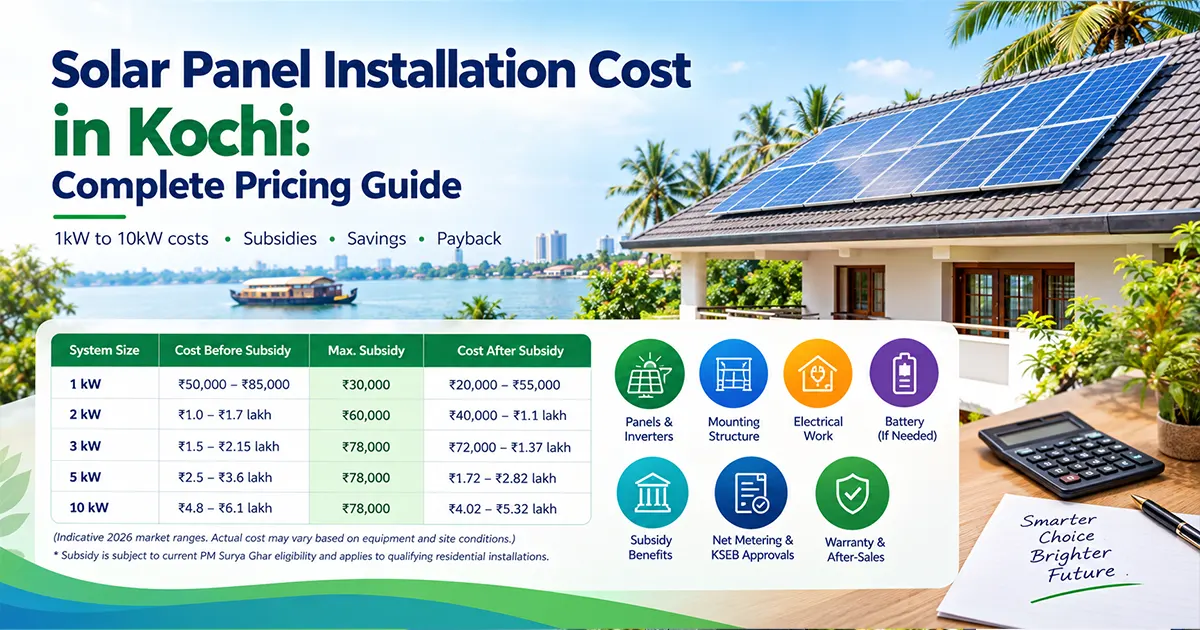
Solar panel installation in Kochi typically costs around ₹50,000–₹85,000 for a 1 kW residential on-grid system and can rise to roughly ₹5–₹6 lakh or more for a 10 kW system before subsidy. The final price depends on system capacity, panel and inverter selection, mounting structure, roof conditions, electrical work and whether the system includes battery storage.
Current Kochi and Kerala market quotations vary considerably. Recent published local estimates put 3 kW residential on-grid systems roughly between ₹1.5 lakh and ₹2.15 lakh, while 5 kW systems are commonly quoted around ₹2.5 lakh–₹3.6 lakh before subsidy.
Eligible residential customers can further reduce the effective cost through the PM Surya Ghar: Muft Bijli Yojana, which currently provides up to ₹78,000 in Central Financial Assistance for eligible rooftop solar installations.
This guide explains what you can realistically budget for solar in Kochi and how to compare quotations properly.
How Much Does Solar Panel Installation Cost in Kochi?
The price of rooftop solar should be considered as a complete installed-system cost, not simply the price of solar panels.
Based on recently published Kochi and Kerala market estimates, homeowners can use the following broad planning ranges:
| Solar Capacity | Indicative Cost Before Subsidy | Maximum Central Subsidy* | Indicative Cost After Subsidy |
| 1 kW | ₹50,000–₹85,000 | ₹30,000 | ₹20,000–₹55,000 |
| 2 kW | ₹1.0–₹1.7 lakh | ₹60,000 | ₹40,000–₹1.1 lakh |
| 3 kW | ₹1.5–₹2.15 lakh | ₹78,000 | ₹72,000–₹1.37 lakh |
| 5 kW | ₹2.5–₹3.6 lakh | ₹78,000 | ₹1.72–₹2.82 lakh |
| 10 kW | ₹4.8–₹6.1 lakh | ₹78,000 | ₹4.02–₹5.32 lakh |
These are indicative 2026 market ranges, not official fixed prices. Recent Kochi and Kerala installers publish overlapping but different quotations depending on equipment and project specifications.
*Subsidy is subject to current PM Surya Ghar eligibility and applies to qualifying residential rooftop installations. Commercial projects should not assume that these residential subsidy amounts apply.
What Is the Cost of 1 kW, 2 kW, 3 kW, 5 kW and 10 kW Solar Systems?
1 kW Solar System Cost in Kochi
A 1 kW on-grid rooftop system can broadly cost ₹50,000–₹85,000 before subsidy, depending particularly on module choice, structure and site conditions. Published Kerala estimates fall within this broad range.
Under PM Surya Ghar, an eligible residential 1 kW system can receive ₹30,000 CFA.
A smaller system may suit households with relatively low electricity consumption and limited roof space.
2 kW Solar System Cost
A 2 kW residential system can broadly fall around ₹1 lakh–₹1.7 lakh before subsidy.
Eligible households can currently receive up to ₹60,000 CFA for 2 kW.
Government guidance associates approximately 1–2 kW systems with households consuming up to around 150 units per month, although actual sizing should still consider the site's generation potential and future consumption.
3 kW Solar System Cost
A 3 kW on-grid system is one of the commonly discussed residential capacities in Kerala. Recent published estimates put the cost at approximately ₹1.5 lakh–₹2.15 lakh before subsidy.
Eligible residential customers can receive the maximum ₹78,000 Central subsidy at 3 kW.
5 kW Solar System Cost
A 5 kW system may cost approximately ₹2.5 lakh–₹3.6 lakh before subsidy based on current local market estimates.
The residential subsidy does not continue increasing proportionally beyond 3 kW. For an eligible 5 kW household installation, the current CFA remains capped at ₹78,000.
10 kW Solar System Cost
A 10 kW rooftop project may broadly cost ₹4.8 lakh–₹6.1 lakh or more, depending on equipment, structure and project complexity.
Larger systems are often considered for high-consumption residences or commercial properties, but system size should be based on actual electricity usage and applicable grid rules rather than simply maximizing available roof space.
What Factors Affect Solar Installation Cost in Kochi?
Two 5 kW systems can have substantially different prices because “5 kW” describes capacity—not the quality or complexity of the installation.
The major cost variables are:
Solar panels: Module manufacturer, wattage, efficiency and technology affect material cost.
Inverter: The inverter type, brand, capacity, MPPT configuration, monitoring features and warranty affect price.
Mounting structure: Standard low-height mounting normally costs less than elevated structures designed to keep roof space usable.
Roof condition: Sloped roofs, tiled roofs, difficult access, weak structures or complicated waterproofing requirements can add cost.
Cable distance: A longer distance between panels, inverter and electrical interconnection increases cabling and labour requirements.
Electrical protection: Earthing, surge protection, AC/DC distribution boxes and other safety equipment contribute to system cost.
Monitoring: Advanced monitoring or panel-level monitoring may increase the initial investment.
KSEB itself notes that additional structural requirements for slanted roofs or obstructions, additional cable length and some metering requirements can create costs beyond a base system price.
For Kochi properties, installers should also consider prolonged rainfall, humidity and coastal exposure when selecting structures and outdoor equipment.
On-Grid vs Off-Grid vs Hybrid Solar: Which Costs More?
On-grid systems usually have the lowest upfront cost because they operate without a large battery bank. Off-grid and hybrid systems generally cost more because energy storage, battery-compatible equipment and additional controls must be included.
On-Grid Solar
An on-grid system includes solar modules, an inverter and grid interconnection but usually no battery backup.
During sunny periods, solar electricity can serve your property, with applicable surplus export handled under the prevailing grid arrangement.
KSEB explains that under net metering, solar electricity is first used for the consumer's own requirements and surplus can be exported, with imports and exports recorded through a bidirectional meter.
On-grid is generally the most attractive option when the main objective is electricity-bill reduction and return on investment.
Off-Grid Solar
Off-grid solar includes battery storage because the property cannot depend on the utility grid whenever solar generation is unavailable.
Battery capacity can substantially increase project cost.
The more hours of backup and the larger the electrical loads you want to operate, the larger—and more expensive—the battery system becomes.
Hybrid Solar
A hybrid system combines grid connection with battery storage.
It can provide some backup capability while retaining grid connectivity, but its upfront price is normally higher than a comparable on-grid installation.
When comparing a hybrid quotation, ask separately for:
solar PV cost + hybrid inverter cost + battery capacity + battery cost + expected battery replacement considerations.
Otherwise, it becomes difficult to understand why one quotation is significantly more expensive.
How Much Solar Subsidy Can Residential Customers Get in Kerala?
Under the current PM Surya Ghar: Muft Bijli Yojana, eligible residential consumers receive Central Financial Assistance based on rooftop solar capacity:
- 1 kW: ₹30,000
- 2 kW: ₹60,000
- 3 kW: ₹78,000
- Above 3 kW: maximum CFA remains ₹78,000
The scheme provides ₹30,000 per kW for the first 2 kW and ₹18,000 for the additional capacity up to 3 kW, after which residential CFA is capped.
The programme continues to operate in 2026. A July 2026 Ministry of New and Renewable Energy update reported nearly 39.7 lakh rooftop systems installed under PM Surya Ghar by July 22, 2026.
For official programme information, homeowners should refer to the Government's PM Surya Ghar guidance. PM Surya Ghar subsidy information from PIB
Always confirm current eligibility and documentation before assuming the subsidy while planning your budget.
How Do Panels, Inverters and Batteries Affect the Final Price?
Solar Panel Type
Higher-efficiency modules can sometimes reduce the roof area required for a given capacity, but they may cost more.
Instead of asking only whether a panel is “premium,” request the exact:
manufacturer,
model number,
wattage,
efficiency,
product warranty,
and performance warranty.
Inverter
The inverter converts electricity generated by solar modules into usable AC electricity.
Different brands, capacities and technologies can produce meaningful price differences. A very low-cost quotation may sometimes use an inexpensive inverter even when the panels appear comparable.
Battery
Battery storage is one of the biggest additions to the cost of an off-grid or hybrid system.
For example, a household wanting only essential backup for fans, lights and Wi-Fi requires a very different battery configuration from one expecting to operate air conditioners and other large appliances during outages.
The installer should calculate backup needs before specifying battery capacity.
Mounting Structure
Standard rooftop mounting may be relatively straightforward.
An elevated structure designed to preserve terrace use requires additional material and engineering, increasing cost.
Properties close to Kochi's coastline should also discuss material selection and corrosion protection with the installer.
How Much Electricity Can Rooftop Solar Generate in Kochi?
KSEB states that 1 kWp of grid-interactive rooftop solar installed on a south-facing roof can generate approximately 4–6 units per day, with actual generation varying according to weather.
Using that broad KSEB figure, a theoretical 3 kW installation could produce roughly:
3 kW × 4–6 units = 12–18 units/day
However, this should not be treated as a guaranteed output.
Actual generation depends on shading, orientation, system losses, module temperature, weather, roof design, equipment performance and maintenance.
The installer should ideally provide an estimated annual generation figure based on your particular roof, rather than promising the same production for every property.
How Much Can Solar Reduce Your Electricity Bill?
Your solar savings depend on three major numbers:
Electricity generated × value of electricity consumed/exported − ongoing costs
Consider a simplified example.
Suppose a household's solar installation generates 5,000 units in a year and those units have an average effective electricity value of ₹7.
Annual value would be:
5,000 × ₹7 = ₹35,000
If the net investment after subsidy were ₹1.4 lakh:
₹1,40,000 ÷ ₹35,000 = approximately 4 years
This is only an illustration. It is not a guaranteed Kochi payback period because KSEB tariffs, export treatment, system production and household consumption vary.
Recent local installers commonly publish payback estimates around 4–6 years for residential on-grid systems, but the actual result should be calculated using your electricity bills and proposed generation.
Be cautious of a solar provider in Kochi promising a specific payback period without first reviewing your electricity consumption.
What Should a Solar Installation Quotation Include?
A professional quotation should make it possible to compare two providers on equal terms.
At minimum, check for the exact system capacity, panel manufacturer and model, number and wattage of modules, inverter brand/model/capacity, mounting structure specification, AC/DC cabling, earthing and protection equipment, monitoring, installation labour, transportation, KSEB/net-metering assistance, GST and other taxes, module and inverter warranties, workmanship warranty, expected annual generation, maintenance terms and any explicitly excluded costs.
For example, two companies may quote:
Provider A: ₹2.85 lakh
Provider B: ₹3.10 lakh
The ₹25,000 difference means little until you know whether both quotations contain the same inverter quality, structure, electrical protection, monitoring, warranty and approval support.
This is why comparing only “price per kW” can be misleading.
Consumers evaluating local solar solutions in Kochi can also review Compassenso when researching solar installation options. Ask any provider you shortlist for a site-specific quotation rather than relying solely on advertised package pricing.
Final Thoughts
For budgeting purposes, residential on-grid solar installation in Kochi currently spans roughly ₹50,000–₹85,000 for 1 kW, ₹1.5–₹2.15 lakh for 3 kW, and around ₹2.5–₹3.6 lakh for 5 kW, while larger 10 kW projects can approach ₹5–₹6 lakh or more before subsidy.
But price should not be the only deciding factor.
A better buying process is:
Review electricity bills → conduct site survey → calculate capacity → select equipment → estimate generation → calculate subsidy → compare complete quotations → evaluate warranty and service.
For eligible residential consumers, the maximum current PM Surya Ghar CFA of ₹78,000 can meaningfully reduce the initial investment.
Ultimately, the best quotation is not necessarily the cheapest. It is the one that clearly explains what you are paying for, how much electricity the system is reasonably expected to generate, what assumptions were used and who will support the installation over its operating life.
Frequently Asked Questions
How much does a 3 kW solar system cost in Kochi?
A reasonable 2026 planning range is approximately ₹1.5 lakh–₹2.15 lakh before subsidy, based on published Kochi and Kerala market estimates. Eligible residential customers can receive up to ₹78,000 in Central subsidy, subject to scheme requirements.
How much does a 5 kW solar system cost in Kochi?
Published local estimates broadly place a 5 kW on-grid system around ₹2.5 lakh–₹3.6 lakh before subsidy. Equipment selection, roof structure and installation complexity can move the price outside this range.
Is there a ₹78,000 subsidy for a 5 kW solar system?
Eligible residential installations above 3 kW can still receive the maximum ₹78,000 CFA, but the subsidy does not keep increasing beyond 3 kW under the current PM Surya Ghar structure.
Which is cheaper: on-grid or hybrid solar?
On-grid solar is normally cheaper because it does not require a large battery system. Hybrid systems cost more because batteries and battery-compatible equipment are added.
How many units does a 3 kW solar plant generate?
Using KSEB's broad guidance of approximately 4–6 units per day for each kWp on a suitably oriented roof, 3 kW could theoretically produce around 12–18 units per day. Actual output varies with weather, shading and site conditions.
Does solar work during Kochi's monsoon?
Solar panels continue producing electricity under daylight, but cloudy and rainy weather can reduce generation. KSEB notes that PV generation varies according to weather conditions.
How long does it take to recover the cost of rooftop solar?
A well-sized on-grid residential installation may sometimes achieve payback in roughly 4–6 years, based on published Kerala installer estimates, but actual payback depends on project cost, subsidy, electricity tariffs, generation and usage patterns.
Should I get multiple quotations before installing solar?
Yes. Compare at least the equipment specifications, mounting structure, electrical components, estimated generation, warranties, approval assistance, service terms and complete project cost rather than comparing only the final price.