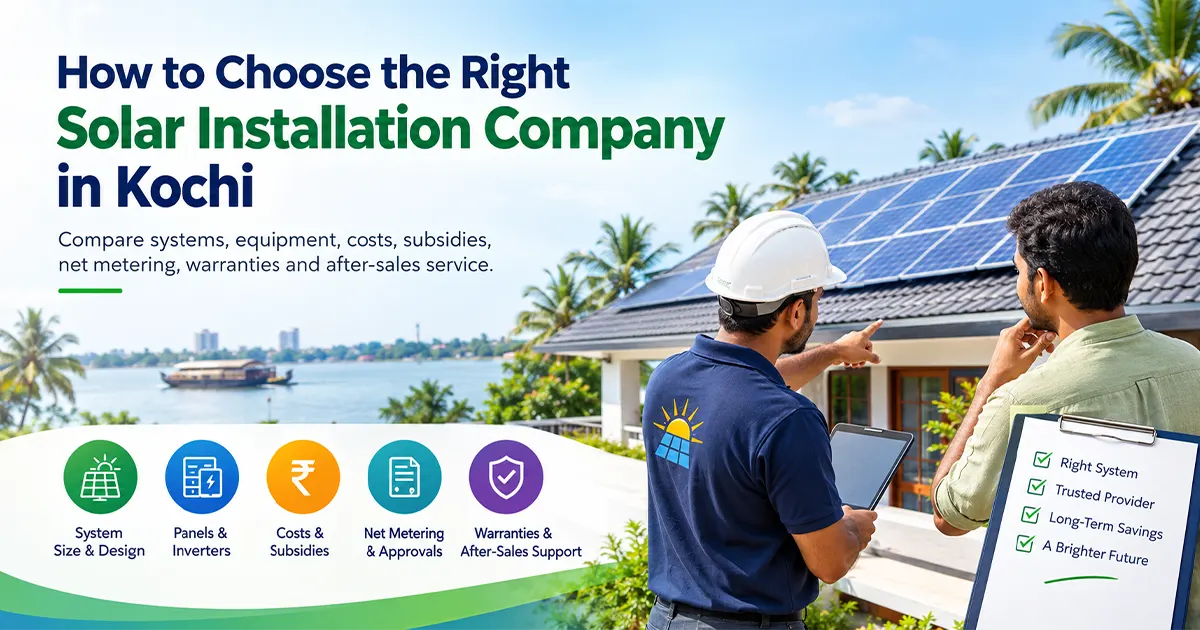
Choosing the right solar installation company in Kochi requires more than comparing the lowest price per kilowatt. A reliable provider should assess your electricity consumption and roof, recommend an appropriately sized system, use compliant equipment, provide transparent warranties, handle required approvals, and offer monitoring and after-sales support.
For Kochi property owners, local conditions also matter. Roof type, shading from nearby buildings or trees, coastal weather exposure, available roof area, electricity consumption and the applicable KSEB connection all influence system design.
Before selecting a solar provider in Kochi, compare companies on technical design and long-term support—not simply the number of panels included in the quotation.
What Should You Look for When Choosing a Solar Installation Company in Kochi?
A professional solar company should be able to explain why a particular system has been recommended for your property.
Start by evaluating these areas:
- Experience with residential or commercial rooftop installations
- Technical site-assessment process
- Solar module and inverter specifications
- Mounting-structure quality
- Electrical protection and earthing
- Expected annual generation
- Workmanship and equipment warranties
- KSEB/net-metering assistance where applicable
- Monitoring and maintenance
- After-sales response
Be cautious when a company recommends a 3 kW, 5 kW or 10 kW system immediately without first asking about your electricity consumption and roof.
The correct system is based on the property—not on whichever package the installer wants to sell.
How Can You Verify a Solar Company's Experience, Certifications and Previous Projects?
Ask for completed projects similar to yours and verify the company's role in those installations. Look at system size, location, equipment used, installation date and whether the provider continues to support the customer after commissioning.
A company showing hundreds of project photographs is less useful than one that can demonstrate relevant experience.
For example, if you need solar for a 2,000 sq. ft. home, ask for comparable residential installations. If you operate a hotel, office, warehouse or commercial facility, request examples involving similar load profiles and roof conditions.
Also check independent customer reviews, particularly comments about:
installation quality,
project delays,
approval assistance,
post-installation service,
and warranty response.
For residential projects seeking benefits under government schemes, confirm whether the vendor meets the current requirements of the relevant programme and portal.
The KSEB rooftop solar portal provides information and documents related to empanelled developers and the National Portal for Rooftop Solar.
Do not rely on a salesperson saying, “We are approved.” Ask approved by whom, under which programme, and whether that status is currently valid.
What Type and Capacity of Solar System Is Right for Your Home or Business?
The appropriate rooftop solar capacity depends primarily on electricity consumption, usable roof area, shading, sanctioned/connected load, daytime consumption and your financial objective. System sizing should follow an analysis of your electricity bills and site rather than a standard package.
A useful starting point is your last 6–12 months of electricity bills.
The installer should examine:
Annual electricity consumption: How many units (kWh) do you actually use?
Daytime load: Commercial properties often consume substantial electricity while solar is generating.
Roof space: Not all roof area is usable because of tanks, staircases, setbacks, shadows and access requirements.
Shading: Even a physically large roof may have limited solar potential if surrounding structures or trees create significant shadows.
Future demand: Are you planning air-conditioning, an EV, additional equipment or property expansion?
For example, two Kochi homes may both have similar roof areas, but one consumes 180 units per month while another consumes 500 units. Automatically recommending identical systems would not make sense.
Government guidance under PM Surya Ghar similarly links indicative residential system sizes to average monthly consumption: 1–2 kW for 0–150 units, 2–3 kW for 150–300 units, and above 3 kW for consumption exceeding 300 units. These are scheme guidance ranges, not a substitute for detailed site design.
What Should You Check About Solar Panels and Inverters?
Do not compare quotations only by statements such as “premium panel” or “Tier-1 inverter.”
Ask for the exact manufacturer and model number.
For solar modules, compare:
- Rated wattage
- Module efficiency
- Product warranty
- Performance warranty
- Technology/type
- Manufacturer
- Applicable certifications/listings
MNRE maintains the Approved List of Models and Manufacturers (ALMM). As of August 2026, MNRE had an updated List-I for solar PV modules, and ALMM requirements apply to categories including government-assisted, government-scheme and net-metering projects as specified under the order.
For the inverter, check:
- Brand and model
- Rated AC output
- Compatibility with the proposed array
- MPPT configuration
- Monitoring capabilities
- Warranty
- Service availability
- Applicable safety/compliance requirements
MNRE also maintains standards and quality-control documentation covering solar PV modules, inverters and other solar components.
What About the Mounting Structure and Electrical Components?
Panels and inverters receive most of the attention, but installation quality also depends heavily on the components connecting everything together.
Ask what material and design will be used for the mounting structure and how it will be fixed to your roof.
This is particularly relevant in Kochi, where outdoor installations experience substantial rain and humid coastal conditions.
The installer should assess structural suitability and consider wind loading, drainage, corrosion exposure and waterproofing implications rather than simply drilling into the roof and mounting panels.
The quotation should also clearly specify important balance-of-system components such as:
DC and AC cabling,
connectors,
distribution/protection boxes,
earthing,
surge protection,
and appropriate isolating/protection devices.
A cheaper quotation may sometimes achieve its price by reducing quality in components that are less visible than the solar panels.
How Much Does Solar Panel Installation Cost in Kochi?
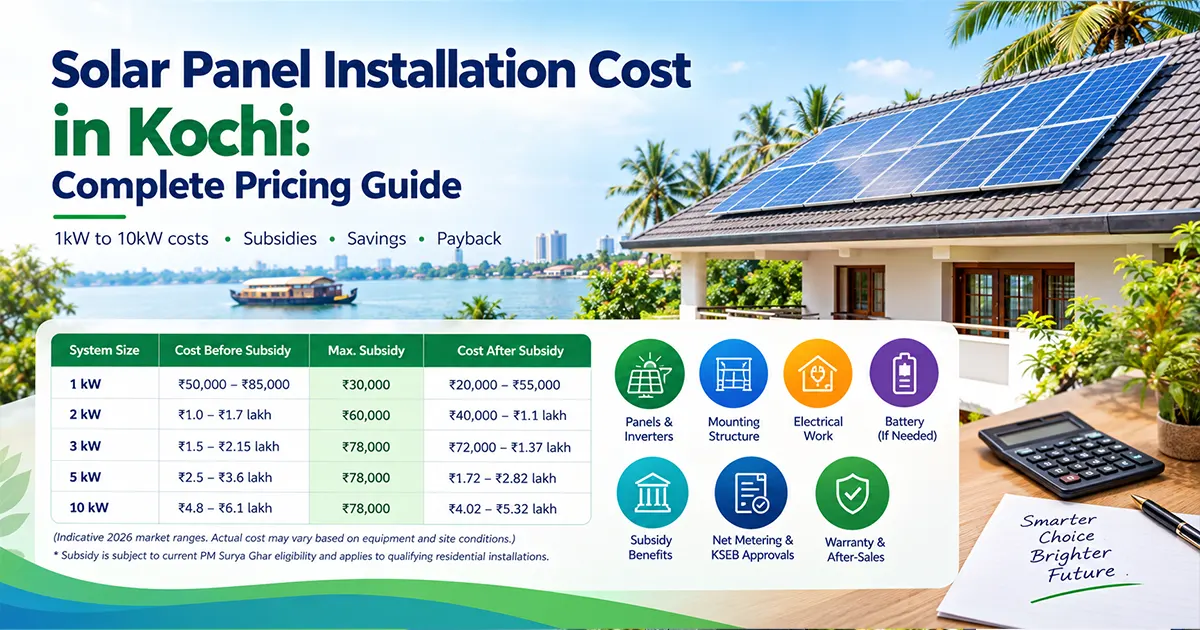
There is no single fixed solar installation price in Kochi. Total project cost depends on system capacity, module and inverter selection, mounting structure, roof conditions, electrical work, cable length, monitoring, approvals, batteries where applicable, and the scope of installation and after-sales service.
This makes ₹/kW comparisons useful only when the specifications are genuinely comparable.
Suppose:
Company A: ₹2.2 lakh
Company B: ₹2.5 lakh
Company C: ₹2.7 lakh
The ₹2.2 lakh proposal is not automatically the best.
Company B might include a better-supported inverter, stronger mounting structure, additional electrical protection, monitoring, approval assistance and a longer workmanship warranty.
Request an itemized quotation containing at least:
| Item | What to Compare |
| Solar modules | Brand, model, wattage, quantity |
| Inverter | Brand, model, capacity |
| Structure | Material and mounting method |
| Electricals | Cable/protection/earthing scope |
| Monitoring | App/portal and data access |
| Installation | Included scope |
| Approvals | Included or separately charged |
| Warranty | Product + workmanship |
| Maintenance | Included period and exclusions |
Compare total project value, not only headline price.
What Solar Subsidies Are Available in Kerala?
For eligible residential rooftop solar installations, the central PM Surya Ghar: Muft Bijli Yojana provides Central Financial Assistance.
The published subsidy structure is:
- 1 kW: ₹30,000
- 2 kW: ₹60,000
- 3 kW or above: ₹78,000
The subsidy is capped at the support applicable to 3 kW under the scheme.
These figures are for eligible residential installations under the scheme and should not be assumed to apply automatically to commercial solar projects.
Because programme rules can change, verify the current eligibility, vendor and equipment requirements before paying an installer based on an expected subsidy.
The Government of India's PM Surya Ghar information via PIB provides an authoritative overview of the scheme.
How Do Net Metering and KSEB Approvals Work?
A grid-connected rooftop solar installation cannot simply be connected to the electricity network without following the applicable utility process. In Kerala, grid-interactive rooftop solar applications are processed through the relevant KSEB rooftop solar process, including technical feasibility and interconnection requirements.
KSEB's FAQ states that applicants must inform the utility and apply for grid-interactive rooftop solar through the Solar Rooftop Portal–Kerala. KSEB then checks technical feasibility and responds through the portal.
The KSEB portal also provides documentation for inspection approval and a net-meter agreement format.
Net-metering rules have also evolved over time. Kerala's regulatory framework has been subject to amendments and newer regulatory proposals, so avoid relying on an old blog post or salesperson's explanation of export credits, banking or allowable capacity.
Before installation, ask the provider to explain the currently applicable process for your consumer category and system size.
What Should a Professional Solar Site Assessment Include?
A proper site visit should involve more than measuring the dimensions of the roof.
The installer should evaluate:
Electricity bills: Preferably several months to understand consumption.
Roof: Dimensions, condition, type and usable area.
Shading: Trees, water tanks, neighbouring buildings and other obstructions.
Orientation and layout: Where panels can realistically be positioned.
Electrical system: Existing connection, distribution board and interconnection requirements.
Cable route: Distance between array, inverter and interconnection point.
Installation environment: Access, drainage and weather exposure.
The final proposal should explain the proposed capacity, panel layout and estimated generation.
If a provider gives a final quotation entirely through WhatsApp based only on “How many units is your bill?” without understanding the property, ask how the design assumptions were determined.
What Should Installation and Commissioning Include?
Once the design and required approvals are ready, professional installation generally includes mounting the structure, installing modules, wiring the DC side, installing the inverter, completing AC interconnection and protection, earthing, testing and commissioning.
After installation, you should receive documentation covering the equipment installed and relevant warranty information.
You should also know how to access the inverter or system-monitoring platform.
Monitoring is increasingly important: MNRE issued compliance guidance in August 2026 concerning inverter-level generation data and storage of inverter-level data for rooftop solar systems.
Ask the installer to show you how to check:
daily generation,
monthly generation,
system status,
and fault/error notifications.
What Should You Ask About Warranties and After-Sales Service?
Separate equipment warranties from the installer's own workmanship and service commitments. A 25-year module performance warranty does not mean every component or installation problem is covered for 25 years.
Ask specifically:
How long is the solar module product warranty?
What does the performance warranty guarantee?
How long is the inverter warranty?
Who handles an inverter warranty claim?
What is the workmanship warranty?
Are mounting and roof-related installation issues covered?
How quickly are service requests normally attended?
Is remote monitoring available?
Are scheduled inspections or cleaning included?
What happens if the installer goes out of business?
Get important warranty commitments in writing.
How Should You Evaluate Expected Solar Energy Savings?
Do not choose an installer simply because the salesperson promises “zero electricity bill.”
Ask for an estimated annual generation figure and the assumptions behind it.
Savings depend on system generation, your consumption pattern, applicable tariff, self-consumption, exported energy and current utility rules.
For businesses with significant daytime consumption, a large share of solar generation may be consumed directly on site. Residential consumption patterns may be different.
A useful proposal should therefore show:
estimated annual generation → expected self-consumption/export → estimated bill reduction
rather than only claiming a percentage saving.
Companies offering solar solutions in Kochi should be able to explain these calculations in terms that a customer can understand.
Questions to Ask Before Choosing a Solar Provider in Kochi
Before signing a contract, ask:
- How did you calculate the recommended system size?
- What annual generation do you estimate?
- Which exact module and inverter models will you install?
- Are the proposed components compliant with current requirements?
- What mounting structure will you use?
- What protections and earthing are included?
- Who handles KSEB applications and approvals?
- Am I eligible for a subsidy, and what requirements apply?
- What happens if subsidy approval is delayed or rejected?
- What warranties apply to modules, inverter and workmanship?
- Who provides service after installation?
- How will I monitor generation?
- What is excluded from the quotation?
- What happens if actual site conditions require additional work?
A provider willing to answer these questions clearly is easier to evaluate than one relying primarily on discounts or sales claims.
Property owners exploring rooftop solar locally can also review Compassenso when comparing solar installation options in Kochi. Before proceeding, request a site-specific proposal covering system sizing, equipment, projected generation, warranties and the approval process.
Final Thoughts
Choosing the right solar installation company in Kochi should follow a simple sequence:
Analyse electricity use → assess the roof → determine system size → compare equipment → verify installer experience → understand approvals/subsidies → compare warranties → evaluate projected generation and service.
The lowest quotation is not necessarily the lowest long-term cost, and the largest solar system is not necessarily the right one.
A good installer should be willing to explain why the proposed capacity is suitable, what equipment is being installed, how much electricity the system is expected to generate, what approvals are required and who will support the system after commissioning.
That technical transparency is one of the strongest indicators to look for when selecting a solar installation partner.
Frequently Asked Questions
How do I choose a good solar company in Kochi?
Compare relevant installation experience, site-assessment quality, equipment specifications, warranties, KSEB approval assistance, generation estimates, monitoring and after-sales support. Do not choose solely on the lowest ₹/kW quotation.
What size solar system does my home need?
System size depends on electricity consumption, usable roof area, shading, sanctioned load and future requirements. Reviewing 6–12 months of electricity bills is a useful starting point.
How much subsidy is available for rooftop solar in Kerala?
Under PM Surya Ghar, eligible residential households can receive ₹30,000 for 1 kW, ₹60,000 for 2 kW and ₹78,000 for 3 kW or higher, subject to current scheme eligibility and requirements.
Is net metering available for rooftop solar in Kerala?
Kerala has a regulatory framework for grid-connected renewable-energy systems and net metering. The exact eligibility and energy-accounting rules depend on the current regulations, consumer category and system configuration, so verify current KSEB/KSERC requirements before installation.
Should I choose the cheapest solar installer?
Not automatically. Compare the exact panel and inverter models, mounting structure, electrical protection, installation scope, approvals, warranties and after-sales service before comparing final prices.
How long do solar panels last?
Solar PV systems are long-term assets. MNRE itself notes that solar PV installations are generally set up for around 25 years, which is one reason module reliability and long-term warranty considerations are important.
Do I need KSEB approval before installing grid-connected solar?
Yes, grid-interactive rooftop installations need to follow the applicable utility process. KSEB states that applications are processed through its rooftop solar portal, where technical feasibility is assessed.
What warranty should I check before buying rooftop solar?
Check the module product and performance warranties, inverter warranty, mounting/other component warranties and, importantly, the installer's workmanship and service warranty. Ask who handles claims and get commitments in writing.